
[01] Start Designing Your RPG
Ok so I’ve settled in on the couch and have started to watch the first few introductory videos for the course. So.. so far, so good. It was near the end of the fourth video when I get hit with my first “Challenge” screen. These screens pop up in almost every video and present the viewer with an opportunity to perform a few tasks before resuming the video. Now in all honesty, while watching courses like this before I wouldn’t even attempt the challenges. I would just wait a few seconds for the inevitable “Alright welcome back” message that would then proceed to explain the solution for the challenges just set forth. This time however I actually want to make something, so I intend to follow the directions I’m given.
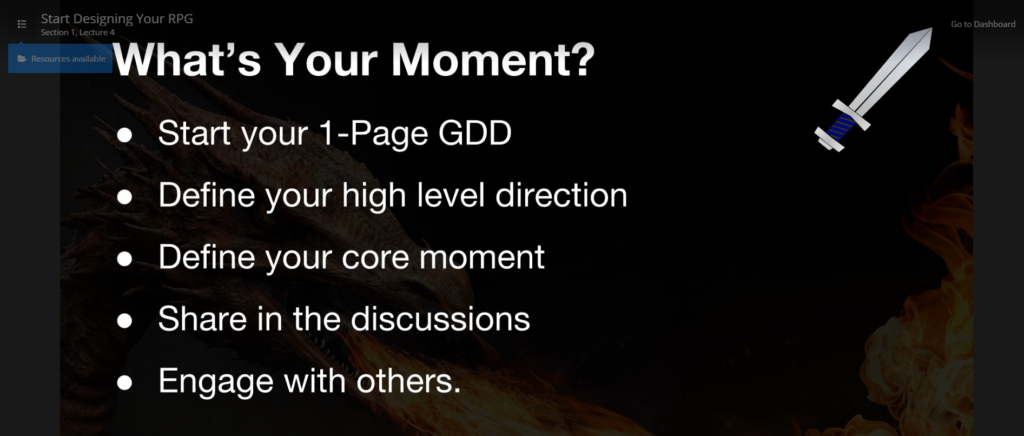
So the first challenge screen set forth three major tasks for me to accomplish:
- Start your 1-page Game Design Doc
- Define your high level direction
- Define your core moment
It also invited me to share in the discussions on the forum and engage with other people but meh, tonight I’m anti-social.
So first thing first, I should start that 1-page GDD. Luckily they were nice enough to include a template that I could start with, it’s been awhile since I’ve written a GDD and a nice fill-in-the-blanks form is a welcome start to gently ease me back into the mountains of documents I know are inevitably coming.
Here’s a link to the first draft of my GDD.
The GDD is totally not finished but the gist of it is it’s a Time-Limited Turn-Based Social RPG. Wait. WTF is that??
Well I guess I’ll have to explain myself a bit. First of all the game is Time-Limited. That means that you can only play it for a limited amount of “turns” a day. When those turns are up you can still play the game, but your progress is halted. This may seem like a poor design choice, to restrict the player from playing your game, but I want to experiment with it to see where it goes. Hopefully, with limited turns per day, the player will think carefully about each action they perform and start to take the time to PLAN for future play sessions. It would be nice if this also really drove players to come back to the game every day. Time-Limited also has another meaning in this context. The game is time-limited, meaning it has an end. The game is over when a player completes the objective that all of the players are trying to achieve. So for example, if every knight in the kingdom is trying to rescue the princess and on day 35 a player named SirLancelot manages to rescue her, the game ends. Sir Lancelot wins, and everyone else loses. After a brief period, the game will reset and all players will start new on day 1, eager to be the player that rescues the princess this time!
Turn-Based is pretty self explanatory but it basically means that gameplay consists of “turns” and every player has the same amount of turns each day. It may also mean that the combat is turn-based (which is what I was initially planning on prototyping) but that may change based on how the core of the game feels as it develops.
Social just means that I want you to be able to interact with the other players in the game in various ways. You are essentially playing the game by yourself when you play your turns for the day, but that doesn’t mean that you are playing alone! Having the ability to attack other players, send them messages, and impede their progress is a major part of the game. Also having access to things like leaderboards, achievements, and social network integration is basically a given for this type of game.
So there you have it, a Time-Limited Turn-Based Social RPG!
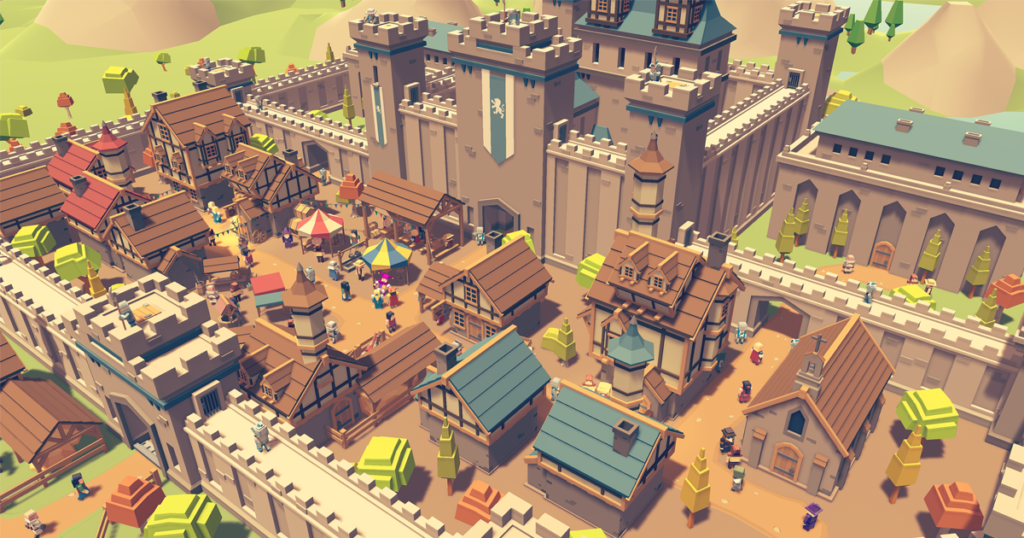
The second task was to define the high level direction of the game, which is basically done by filling out the relevant sections of that GDD template. This just gives you a better idea of what your game is (and isn’t) while still keeping it “loose” enough to allow yourself to find the game as you make it. We’re not backing ourselves into any corners at this point, just basically defining the edges of the game while the middle bit is a bit fuzzy. I also included a reference picture (posted above) to get an idea of how the game looks.
Finally the third task was to define the core moment of the game. As I’m treating this as a prototyping experience, I would ideally like to test out the basic game loop. At this point though I have no idea how involved that loop will be, so I’ve given myself a few solid goals to accomplish:
Three minutes of basic game loop, including basic melee combat (hitting and taking damage) with three different enemy types, and three different locations (2 exterior, 1 interior).
I know that combat is going to be a part of the game loop so I may as well get that implemented as soon as I can, complete with killing enemies so I can add money, XP, etc.. as another component in the loop when it needs to be expanded. I will implement three enemies in the game that will all look different but essentially act the same (all melee fighters) to get an idea of how the various enemies will look and behave. I will also create three different locations to get an idea of the size of the areas in the game, with two of them being exteriors (probably a city and a forest) and one interior (probably a tavern) to see the difference between them. Finally I am aiming for three minutes of gameplay because well, good things come in threes..
– Chris